Closed California Poker Room
Spotlight 29 Casino 46-200 Harrison Place Coachella | 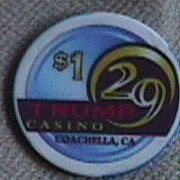 |
760-775-5566 Home to the 2,200 seat Spotlight Showroom which has featured headliners such as Bruno Mars and Dave Chapelle. |
| Name: | Brett Kelman and Jesse Marx, The Desert Sun |
| Date: | Sunday August 7, 2016 |
| Subject: | How Donald Trump got fired by a California casino |
| Message: | The presidential candidate has campaigned on his reputation for great deals. He was bested by a small Indian tribe with big plans.
COACHELLA, Calif. — Fifteen years ago, Donald J. Trump, a real estate mogul with a penchant for profit, came to Southern California, hoping to make a deal. Trump wanted to invest in Spotlight 29, a bingo parlor run by the Twenty-Nine Palms Band of Mission Indians, a tribe of only 12 people. Spotlight 29 was the smallest casino in the Coachella Valley, but Trump saw the potential for big money. So he went for it. Over the next few years, Trump used his reputation to help raise money for a vastly expanded casino, adding slot machines, table games, a swanky nightclub and a private lounge for high rollers. In return, the tribe hired Trump as casino manager while he taught them how the gaming industry worked. In 2002, Spotlight 29 was re-branded with a flashy new name — Trump 29. Donald Trump, left, talks with Dean Mike, then-chairman Donald Trump, left, talks with Dean Mike, then-chairman of the TwentyNine Palms tribe, in 2002. The relationship ended three years later. Trump’s multi-billion dollar resort company was in bankruptcy, and the tribe was looking to cut a deal of its own. Leaders terminated his management contract early, buying out Trump for a measly $6 million — less than the contract had earned him in a single year. Trump's name came off the building. The businessman never returned. The dissolution of Trump 29 made for a twist ending. Some Indian gaming advocates had worried that the larger-than-life tycoon would exploit the tribe, who were relative novices in a cutthroat industry. But today, with the benefit of hindsight, sources agree that it was the tribe who walked away with the better bargain. “When Trump came in, we all thought, ‘Oh gosh, he is going to really run the tables on the tribe,’ and it was actually just the opposite that happened,” said Victor Rocha, an Indian gaming advocate from Temecula. “But it shouldn’t have been a surprise. If you look at anything that guy has done in this industry, he has a lead thumb — it’s the opposite of a golden touch.” Donald Trump, now a Republican presidential candidate, Donald Trump, now a Republican presidential candidate, speaks during a campaign rally in Orlando, Fla., on March 5, 2016. Today, the brash and boisterous businessman is the leading candidate for the Republican presidential nomination, on a seemingly inevitable path to challenge Hillary Clinton for the White House. Trump's campaign platform has been light on specifics, but he has promised to lead the country through “great deals” on healthcare, trade and diplomacy. Trump, however, is not the flawless negotiator that he portrays himself to be, according to interviews with two biographers who have studied the mogul for years. His company has gone bankrupt four times, his luxurious casinos have lost money and he has abandoned a housing project before construction could even begin. The end of Trump 29 adds to a pockmarked resume — suggesting that he's far better at projecting success than he is at actually achieving it. “Purely on his track record as a real estate developer and casino operator, Trump hasn’t demonstrated that he’s a particularly good dealmaker,” said Timothy L. O’Brien, author of “TrumpNation” and a former New York Times reporter. “He has demonstrated that he’s a world-class self-promoter and survivor. But neither of those things make him a good businessman.” Representatives of Trump's presidential campaign did not return multiple requests for an interview. The rise and fall of Trump 29 Trump's troubles in the gambling industry began to show in the late ‘80s, when he took control of the Taj Mahal Casino, a lavish but unfinished resort in Atlantic City. He already owned two other casinos in town and he planned to dominate the market. Instead, Trump saddled the business with junk bonds because he couldn’t secure a prime rate loan. He was forced the following year to give up half of the casino's ownership to creditors, paving the way for his company's first bankruptcy. “He never really buckled down and learned the nuts and bolts of running a casino," O'Brien said. In addition to being a questionable businessman, Trump was a rabid opponent of Indian gaming — when it served his interests. In 1993, Trump lambasted the Mashantucket Pequots, who'd just opened a casino in Connecticut, at a meeting of the House Native American Affairs subcommittee. He accused the tribe of being greedy. He claimed that the mafia had infiltrated tribal casinos across the country. He even questioned if the Pequots were really Indians, saying "they don't look like Indians to me." How Phoenix residents dumped Donald Trump's hotel plans A congressman said it was perhaps the most irresponsible testimony he had ever heard. Trump later said his remarks had been taken out of context: he had been describing the casino's managers, not the tribe, as non-Indians. "I cannot be criticized if I am right," he countered. A decade later, at about the same time that Trump was making deals in Coachella, he was also publicly apologizing for secretly financing offensive advertisements against another tribe. This time his target was the St. Regis Mohawks, who were developing a competing casino in Southeastern New York. Candidate Donald Trump, the man who hates our windmills “He has always been hostile to tribal gaming because he considers any competition a personal affront,” said Michael D’Antonio, author of "Never Enough," a Trump biography. “He’ll use any method to destroy a competitor even if it’s spreading rumors and lies.” Trump 29 casino, circa 2002. All of this — the failed casinos, the stereotyping, the incendiary ads — made Trump and the Twenty-Nine Palms tribe strange bedfellows. As the deal for Trump 29 came together, the California Nations Indian Gaming Association warned that businessmen like Trump looked at tribes for resources, not relationships. The tribe went ahead with it anyway. Darrell Mike, who became tribal chairman in 2007, said his predecessor brokered a deal with Trump because they believed his famous name would bring “spectacular” business to the casino. Years later, when those expectations were still unfulfilled, the tribe decided they'd had enough. Mike described the split not as a deft business move but as a "marriage that didn't work out." But he acknowledged that the divorce had left the tribe on strong footing, with full control of a newly renovated casino. “Today, looking at it now, we are here and we are doing it ourselves. Sometimes in business things don’t work out so well,” Mike said. “But, yes, for my tribe and my family…we did get a good deal.” ~http://www.desertsun.com/story/news/politics/2016/03/21/donald-trump-spotlight-2 9/81860676/ ~ |
This is the first message in this thread. Next message in this thread